Schedule your posts when your audience is online - Facebook | Twitter
Frequency and scheduling go hand-in-hand in so many ways in your social media marketing strategy that it’s hard to plan one without the other.
Followerwonk is a favorite tool of ours to see when your followers are online and to plan accordingly. There’s even integration with Buffer so that you can marry the two together. Here is a sample graph from Followerwonk, charting the most active hours for your followers:
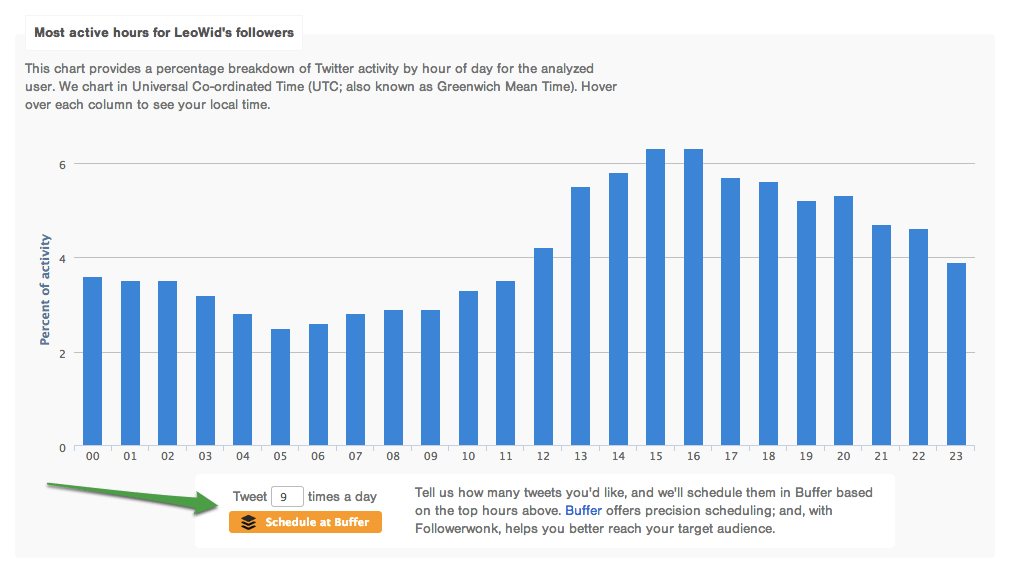
If you would rather hack your social timing yourself, you can consider syncing your post schedule to time zones. Fifty percent of Americans live in the Eastern time zone. A full eighty percent live in Eastern and Central combined. Publishing in accordance with these time zones could be hugely helpful for a national business. West Coasters can schedule tweets really early in their morning (which would be not-so-early in Central and Eastern time) and avoid posting late at their West Coast night.
The late-night infomercial effect
There is, as you might imagine, a flip side to scheduling your posts when your audience is online. We’ll call it the late-night infomercial effect—another fun tidbit from Peter Bray. It goes a little something like this:
When there’s nothing else on, you’re more likely to watch an infomercial.
When there’s little else being tweeted, your tweets are more likely to stand out.
Certain email marketing statistics follow a similar line of thinking. You could see greater open rates and clickthroughs when your email is one of the only ones in the inbox. The data below suggests that 8:00 p.m. to midnight gets the highest opens and clicks.
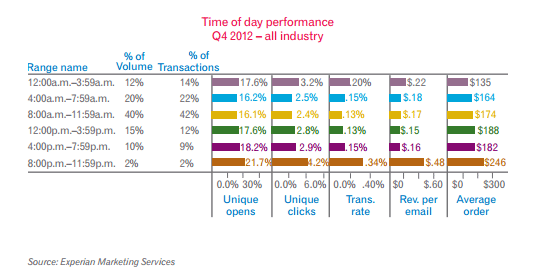
Being one of the lone voices in the inbox could prove beneficial. The same could be said for social media.
Maybe posting on off hours isn’t all that bad after all?
Takeaways
The temptation to write off social media frequency as “it depends” is huge, but I think that the numbers from a few studies do show some general starting points for where to begin.
Post to Twitter at least 5 times a day. If you can swing up to 20 posts, you might be even better off.
Post to Facebook five to 10 times per week.
Post to LinkedIn once per day. (20 times per month)
And always be testing, experimenting, iterating, and improving. The line between informative and annoying may be super slim, but it’s one that you can find with a little practice.
Comments
Post a Comment